AI Job Loss Fears Rise in 2026 as Automation Reshapes the Global Workforce
Introduction
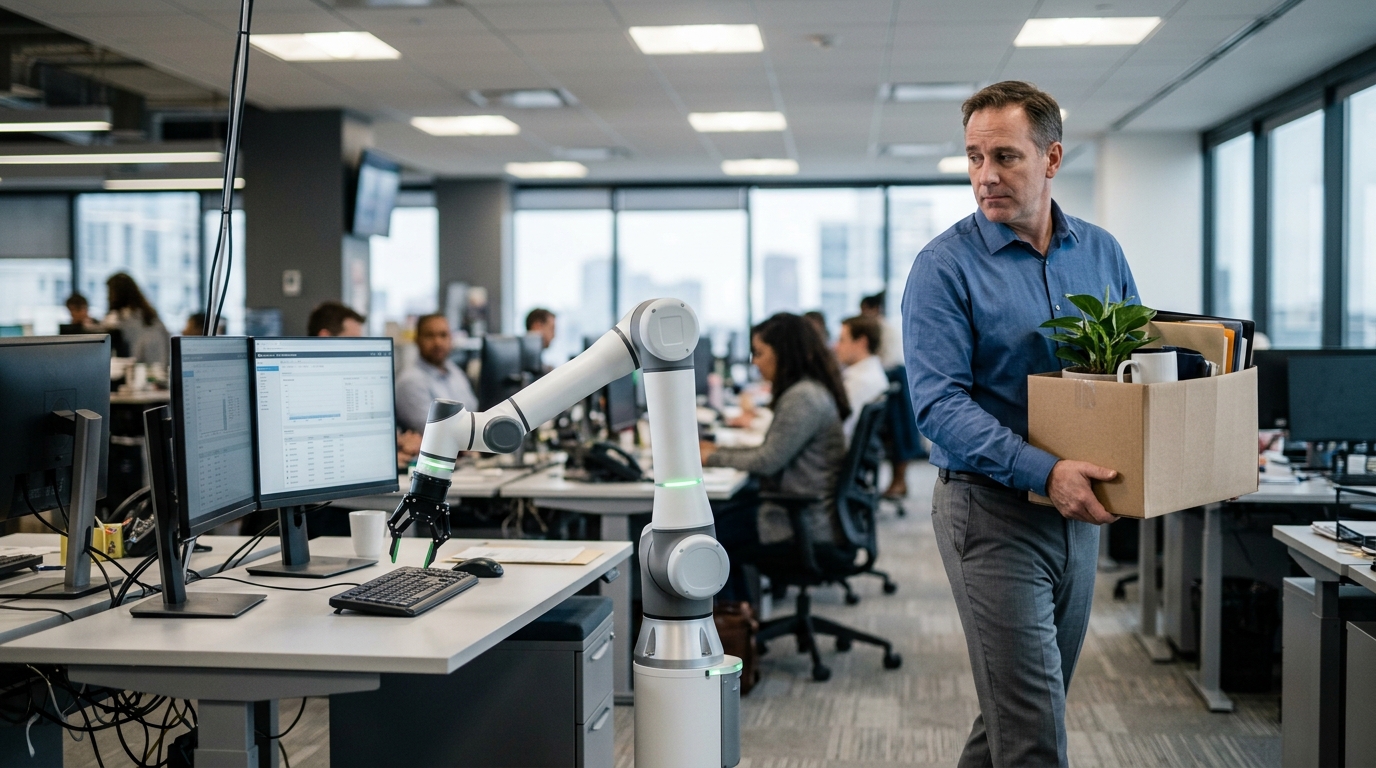
The conversation around artificial intelligence has shifted dramatically in 2026. What was once a story about innovation and efficiency is now increasingly a story about uncertainty and disruption. Across industries, workers are beginning to feel the real impact of automation, as AI systems take over tasks that were once considered safe from technological replacement.
From office jobs to creative roles and industrial labor, automation is no longer limited to repetitive work. It is entering areas that require thinking, analysis and even creativity. This shift has sparked widespread concern among employees, policymakers and economists who are trying to understand how deeply AI will reshape the global workforce.
As companies continue to adopt AI at a rapid pace, the fear is not just about losing jobs—but about how quickly the job market is changing and whether people can keep up.
Why AI Job Loss Fears Are Growing in 2026
The acceleration of AI adoption is the main reason behind rising concerns.
Key Drivers Behind Workforce Disruption
- Rapid improvements in AI capabilities
- Lower operational costs for businesses
- Increasing competition forcing automation
- Demand for faster and more efficient processes
- Availability of advanced AI tools across industries
These factors are pushing companies to rely more on machines than human labor.
Automation Is Expanding Beyond Traditional Roles
Earlier waves of automation mostly affected manual labor and factory jobs. However, the situation in 2026 is very different.
AI is now capable of performing tasks such as:
- Writing and editing content
- Analyzing large datasets
- Customer service through chatbots
- Graphic design and creative production
- Software development assistance
This means even highly skilled workers are now part of the disruption.
Industries Experiencing the Biggest Impact
Customer Service and Support
One of the first industries to feel the impact has been customer service.
AI-powered chat systems can now:
- Handle large volumes of queries instantly
- Provide 24/7 support
- Reduce the need for human agents
As a result, many companies are reducing their support teams.
Media, Content and Creative Fields
The rise of AI content tools has changed how content is produced.
AI can now:
- Generate articles and reports
- Create social media content
- Produce visuals and graphics
While this increases productivity, it also raises concerns about job security for writers, designers and editors.
Manufacturing and Logistics
Automation in factories and warehouses continues to expand.
Technologies include:
- Robotics for assembly lines
- Automated inventory systems
- AI-driven logistics management
These systems reduce reliance on human labor while increasing efficiency.
Finance and Data Analysis
AI is transforming financial services as well.
It can:
- Analyze market trends
- Detect fraud
- Manage risk assessments
This reduces the need for large teams of analysts.
Human Impact: More Than Just Job Loss
Rising Anxiety Among Workers
The psychological impact of automation cannot be ignored.
Workers are experiencing:
- Fear of redundancy
- Career uncertainty
- Pressure to constantly learn new skills
Even those who are currently employed are worried about long-term stability.
Shift Toward a Skills-Based Economy
The future job market is becoming more skills-focused rather than degree-focused.
High-value skills include:
- Digital and AI literacy
- Critical thinking
- Creativity and innovation
- Problem-solving
Workers who adapt quickly may benefit, while others may struggle.
Economic Effects of AI Job Disruption
Productivity Gains vs Employment Risks
AI is significantly improving productivity.
However, this creates a major question:
Can economies grow while jobs decline?
Some economists argue that increased efficiency will lead to new opportunities. Others warn that the transition period could be painful.
Risk of Growing Inequality
Automation may increase the gap between different groups of workers.
Possible outcomes include:
- Higher income for tech-skilled professionals
- Fewer opportunities for low-skill workers
- Uneven economic growth
This imbalance is becoming a key concern for policymakers.
Tech Companies and Workforce Changes
Why Businesses Are Choosing AI
Companies are not adopting AI without reason.
The benefits include:
- Reduced labor costs
- Faster production cycles
- Improved accuracy
- Scalability
In a competitive global market, these advantages are difficult to ignore.
Workforce Restructuring Trends
Instead of hiring large teams, companies are moving toward leaner structures.
This includes:
- Smaller teams with higher productivity
- Increased reliance on automation tools
- Greater demand for specialized talent
Traditional employment models are evolving.

Government Response and Policy Challenges
Pressure on Governments to Act
Governments are under increasing pressure to manage the transition.
Key policy discussions include:
- Job retraining and reskilling programs
- Social safety nets
- Regulation of AI adoption
- Education system reforms
The effectiveness of these policies will shape the future workforce.
Education Systems Must Adapt
Traditional education models are struggling to keep up.
There is growing demand for:
- Practical digital skills
- Continuous learning opportunities
- Flexible education pathways
Lifelong learning is becoming essential.
Opportunities Created by AI
New Careers Emerging
Despite fears, AI is also creating new roles.
Examples include:
- AI specialists
- Data engineers
- Automation consultants
- AI ethics experts
The challenge is that these roles require advanced skills.
Growth of Remote and Digital Work
AI is also enabling new forms of work.
This includes:
- Remote jobs
- Freelance opportunities
- Online businesses
The digital economy continues to expand.
Why This Topic Is Going Viral
AI job loss fears are trending because they directly affect people’s futures.
The topic is being widely discussed because:
- It impacts every industry
- It creates uncertainty about careers
- It raises questions about economic stability
Social media and news platforms are filled with debates on this issue.
Possible Future Scenarios
Scenario One: Smooth Transition
Workers adapt through reskilling and new opportunities emerge.
Scenario Two: Disruption and Unemployment
Automation leads to widespread job losses and economic challenges.
Scenario Three: Human-AI Collaboration
Instead of replacing humans, AI works alongside them, improving productivity.
Expert Outlook
Experts agree that AI will not simply eliminate jobs—it will transform them.
The key factors that will determine the outcome include:
- Speed of technological adoption
- Government policies
- Education and training systems
- Corporate responsibility
The future is uncertain but highly dynamic.
Conclusion
AI job loss fears in 2026 reflect a major turning point in the global workforce. Automation is no longer a distant possibility—it is a present reality reshaping industries and careers.
While the benefits of AI are clear in terms of efficiency and innovation, the social and economic challenges cannot be ignored. The world now faces a critical question: how to balance technological progress with human stability.
The answer will depend on how quickly individuals, businesses and governments adapt to this new era of work.
Frequently Asked Questions
Is AI replacing jobs in 2026?
Yes, AI is automating many roles, but it is also creating new opportunities.
Which jobs are most at risk?
Routine and repetitive jobs are the most vulnerable.
Can people adapt to AI changes?
Yes, through reskilling and continuous learning.
Will AI create more jobs than it destroys?
It is possible, but the transition may take time.
Why is this topic trending?
Because it affects employment, income and the future of work globally.